素材包 · 2026-10-23
内容素材包 · 2026-10-23
基于 arr.club 当日 published signals(2 条),ready-to-copy,John 过目即发。
生成时间:2026-10-24 07:52(北京时间)
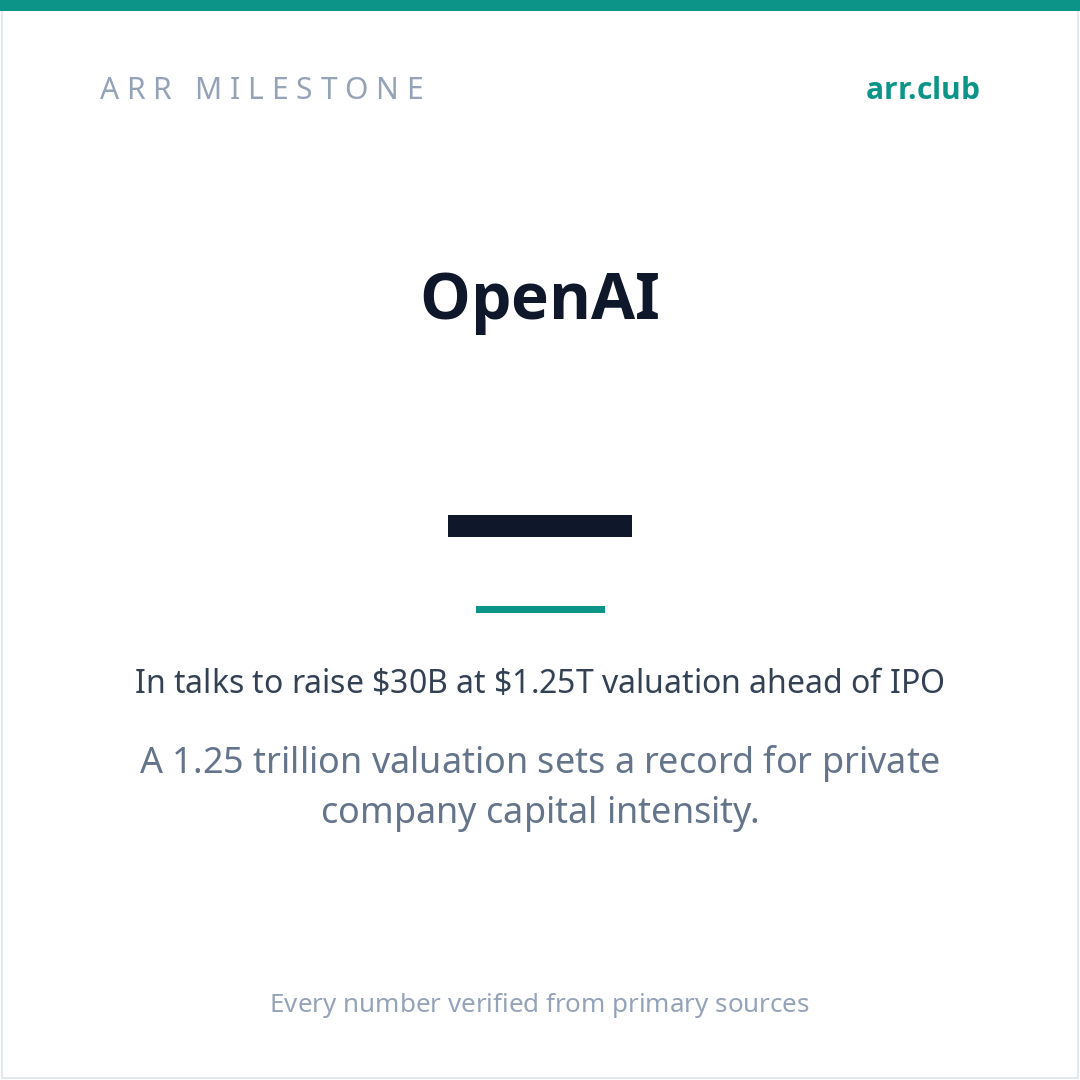
OpenAI — OpenAI in talks to raise $30B at $1.25T valuation ahead of IPO
- ARR:(未披露)
- 来源:https://techcrunch.com/2026/10/22/openai-working-on-new-30b-raise-at-1-25t-valuation-ahead-of-ipo/
X(≤280 字符)
OpenAI reached a $1.25T valuation in talks to raise $30B. This follows a $852B valuation in March.

Private markets are decoupling from reality. A trillion-dollar private company sets an impossible bar for any upcoming IPO.

Tracked live at arr.club
字符数:249
OpenAI moved to secure **$30 billion** in new funding at a **$1.25 trillion** pre-money valuation, signaling that the era of the private mega-cap is far from over. This shift away from an immediate IPO suggests that the company is prioritizing massive, concentrated capital to fuel compute-heavy infrastructure over the public market’s quarterly scrutiny.

The scale of this valuation is unprecedented for a private entity, and it fundamentally changes how we must view the AI landscape:

1. The valuation gap between private and public markets has effectively vanished, as a **$1.25 trillion** price tag would make OpenAI the most valuable private company in history.
2. Capital intensity is the new moat, evidenced by the strategic coupling of this **$30 billion** raise with deals to secure additional computing capacity from UAE investors.
3. The bar for the entire sector is shifting, especially with competitors like Anthropic reportedly eyeing debut valuations between **$1.5 trillion** and **$2 trillion** following their **$65 billion** raise at a **$965 billion** valuation in May.

This move follows a rapid ascent from the **$852 billion** post-money valuation OpenAI commanded in March. While the company filed confidential paperwork for an IPO in June, the decision to pursue this private round suggests they are not yet ready to trade the flexibility of private capital for the constraints of the public exchange.

I track verified ARR and funding milestones like this daily at arr.club.
数据卡片
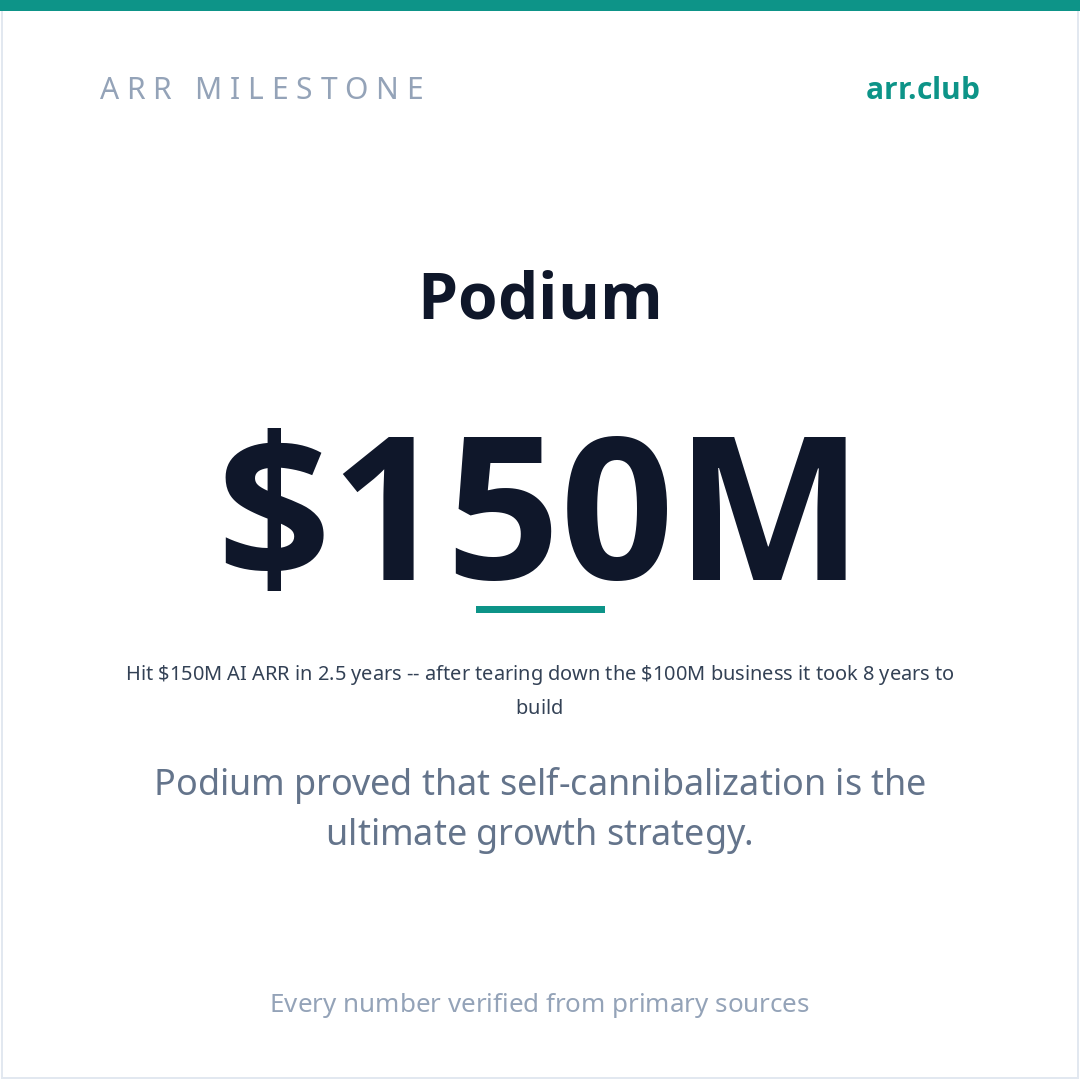
Podium — Podium hit $150M AI ARR in 2.5 years -- after tearing down the $100M business it took 8 years to build
- ARR:$150M
- 来源:https://x.com/ericwilliamrea/status/2113265406316044777
X(≤280 字符)
Podium hit $150M in AI ARR in 2.5 years. This followed a pivot where they tore down a $100M business built over 8 years.

Self-cannibalization is the ultimate founder test. Code is a liability; data and distribution are the only real moats.

Tracked live at arr.club
字符数:266
Podium just crossed **$150M** in AI ARR, achieving in **2.5** years what took them **8** years to build the first time. This isn't just a growth story; it is a masterclass in the brutal necessity of self-cannibalization.

When Podium was already doing over **$100M** in revenue with **100,000+** merchants, co-founder Eric Rea made the decision to tear down the business he spent a decade building. He realized that traditional software was becoming obsolete and that the only way to survive was to rebuild from the ground up as an AI-native operating system.

Here is why this matters for the future of SaaS:

→ Self-cannibalization is the ultimate test of founder conviction. Most companies treat AI as an add-on feature, but Podium treated it as a replacement for their own legacy. Subtraction is far harder than addition, but it is the only way to avoid being disrupted by someone else.

→ AI value is measured by the cash register, not productivity metrics. By cutting response times by **72%** and lifting engagement by **24%**, Podium proved that AI is a revenue-generating engine for small businesses, not just a tool for efficiency.

→ The definition of a moat has shifted. Code is now a liability, while data, scenarios, and distribution are the only true assets. Podium’s second act was faster because they leveraged a decade of deep industry context to build a system that acts as an employee, not just a dashboard.

I track verified ARR milestones like this daily at arr.club.
数据卡片
早期项目内参 · 2026-10-23
过去 7 天融资事件 + 新增早期公司扫描,按 tier-1 机构/轮次/赛道打分取 Top 5。仅 John 可见。
1. Dapta
- 一句话: 为中小企业提供通过 WhatsApp 和电话自动响应、筛选并安排入站线索的 AI 销售代理。
- 融资: 600 万美元,领投/参投方:未披露。
- 为什么值得看: 公司已实现 400 万美元以上的年度经常性收入 (ARR),在 AI 销售自动化领域展现出极强的产品市场匹配度 (PMF) 和增长势头。
- 跟进动作: 建议深入调研其在 WhatsApp 生态中的获客效率及留存数据。
2. YGO
- 一句话: 旅游行业的 AI 基础设施层,将航空公司、酒店和旅行社的库存结构化,使其适配 AI 代理进行预订。
- 融资: 800 万欧元,领投/参投方:未披露。
- 为什么值得看: 仅用六个月即达到 100 万美元 ARR,切中了旅游行业数据碎片化、难以被 AI 调用这一核心痛点。
- 跟进动作: 建议评估其与主流旅游分销系统 (GDS) 的集成深度及壁垒。
3. Tolan
- 一句话: AI 驱动的伴侣与聊天机器人平台,允许用户与可定制的虚拟人格进行互动。
- 融资: 3000 万美元,领投/参投方:USV, Khosla。
- 为什么值得看: 拥有 USV 和 Khosla 等顶级机构背书,处于 AI 消费级应用的前沿,累计融资额已达 1 亿美元。
- 跟进动作: 建议分析其用户留存数据及在同类 AI 社交产品中的差异化竞争优势。
4. Cuttable
- 一句话: AI 广告平台,可将品牌现有资产转化为高性能广告,并根据每场活动的反馈进行自我学习优化。
- 融资: 2000 万美元,领投/参投方:未披露。
- 为什么值得看: 在一年内实现了 20 倍的收入增长,证明了其 AI 驱动的广告创意生成与优化方案在市场上的强劲需求。
- 跟进动作: 建议对比其与现有广告自动化工具的 ROI 表现差异。
5. Qualitate
- 一句话: 针对基础研究的持续智能系统,通过 AI 主持的专家访谈,将专家观点转化为投资和企业团队可用的结构化情报。
- 融资: 2500 万美元,领投/参投方:未披露。
- 为什么值得看: 今年收入运行率增长 10 倍,通过 AI 替代传统人工访谈流程,显著提升了投研领域获取专家洞察的效率。
- 跟进动作: 建议找创始人聊聊其 AI 访谈的深度及数据结构化的准确性。
每日文章
(生成失败:[wechat_deep-s3] ungrounded numbers persist after retry: $268.0m, bold:$250k,已隔离)